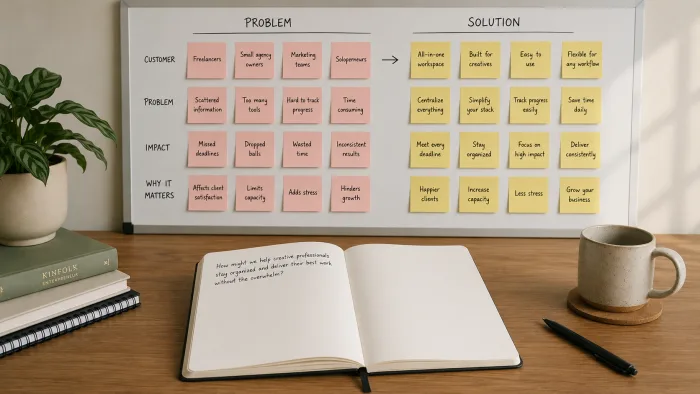
Most startup founders know, in principle, that moving fast is important. They have read enough startup literature to understand that shipping quickly, learning from users, and iterating is how early-stage products find their footing. The advice is sound. The mistake is in what gets treated as the starting point.
The most expensive mistake startups make when building their first product is not rushing the development. It is not choosing the wrong technology stack. It is not skipping the design phase or under-investing in quality. Those are real problems, but they are downstream of a more fundamental one.
The most expensive mistake is building a solution before the problem is fully understood.
It sounds obvious stated plainly. Every founder believes they understand the problem. They have a story about how they encountered it personally, or how users they spoke to described it, or how the market clearly has a gap that their product will fill. That story feels like problem understanding. It is usually problem recognition, which is a different and much less useful thing.
Problem recognition is knowing that a problem exists. Problem understanding is knowing precisely who experiences it, in what context, at what cost, and why the existing solutions fail to address it. The gap between those two things is where most first products go wrong, and where most of the money and time that gets spent on first products is quietly lost.
Problem recognition is knowing that a problem exists. Problem understanding is knowing precisely who experiences it, in what context, at what cost, and why existing solutions fail. Most first products are built on the first and launched into the second.
WHY THIS HAPPENS TO SMART FOUNDERS
Not because they are careless about the problem. Because the incentive structure of early-stage startup culture systematically rewards movement over understanding.
Every framework, every accelerator curriculum, every piece of startup advice centres on speed. Build fast. Ship early. Get to market. The implicit message is that the product itself will teach you what you need to know about the problem, and that the cost of building the wrong thing is lower than the cost of thinking too long before building anything.
That message is partially right. You do learn from building. The product does reveal things about the problem that no amount of pre-build research would surface. But what it reveals, and how expensive those revelations are, depends entirely on how well the problem was understood before the first line of code was written.
A product built on a clear problem understanding produces specific, interpretable feedback. A product built on a vague problem recognition produces confusing, contradictory feedback, because different users are interpreting what the product is for differently, and the product itself does not have a clear enough point of view to resolve the contradiction.
The founder who ships fast with clear problem understanding learns fast. The founder who ships fast with vague problem recognition runs in circles, adding features that some users asked for and others do not need, building complexity into a foundation that was never clear enough to support it.
WHAT BUILDING ON THE WRONG PROBLEM FOUNDATION ACTUALLY COSTS
The features that should not have been built
When the problem is not fully understood, features get prioritised based on what seems logical to the founder or what gets requested loudest by early users, rather than what the product actually needs to solve the problem for the people who have it most acutely.
The result is a product with features that are individually defensible and collectively incoherent. Each feature made sense when it was requested. Together they do not tell a clear story about what the product is for or who it is for. The product tries to be useful to everyone who encounters it and ends up being essential to nobody.
These features do not disappear when the problem understanding improves. They become the technical debt and the UX debt that the next phase of the product has to work around, accommodate, and eventually replace.
The users who were never going to stay
A product built on incomplete problem understanding attracts two kinds of early users: the ones who have the problem the product is actually solving, and the ones who have a superficially similar problem that the product does not actually address.
The second group is harder to see from inside the product because they behave like engaged users in the early stages. They sign up, they try things, they give feedback. But their feedback is shaped by a need the product was not designed to meet, which means acting on it moves the product away from the users it was actually built for.
The churn that results from losing these users gets misread as a product problem. The real problem is a targeting problem that traces back to the original problem definition. The product was not clear enough about who it was for because the problem was not understood clearly enough to make that determination before building.
The rebuild that was always coming
The most visible cost of building on an unclear problem foundation is the version two conversation that happens twelve to eighteen months into most first products. The product has been built, launched, iterated, and grown to a point where the team can see clearly what it should have been from the beginning. But the path from what it is to what it should be runs through a significant rebuild, because the foundations were laid for a problem that is now understood differently than it was when the first line of code was written.
This rebuild is not always avoidable. Some degree of pivoting and rebuilding is natural in early-stage product development. But the scope and cost of the rebuild correlates directly with how far the original problem understanding was from the actual problem. A small misunderstanding produces a small correction. A large misunderstanding produces a rebuild that effectively restarts the product from a better foundation, at a cost in time and money that could have been reduced significantly by investing more in problem understanding before the first build.
The scope of the rebuild that every first product eventually faces correlates directly with the gap between the problem as it was understood before building and the problem as it is understood now. That gap is the cost of building on incomplete foundations.
WHAT GETTING THIS RIGHT ACTUALLY LOOKS LIKE
Getting this right is not about research paralysis or spending months in discovery before writing a line of code. It is about reaching a specific level of clarity about the problem before the product is designed, and using that clarity to make the design and build faster and more certain rather than slower.
The clarity you need before building has four components.
A specific user, not a demographic or a persona, but a concrete description of the person who has this problem most acutely. What do they do, what are they trying to accomplish, and why does the current situation fail them?
The specific moment the problem occurs. Not a general frustration but the specific context in which the user encounters the problem. What triggers it, what do they do when it happens, and what does the failure cost them in time, money, or effort?
Why existing solutions fail. Not that they are bad, but the specific reason they do not solve the problem for this user in this context. This is the gap the product fills, and it needs to be precise enough that the product can be designed around it rather than around a general improvement on what exists.
What success looks like for the user. Not what success looks like for the product, but the specific outcome the user experiences when the problem is solved. This is the standard against which every design decision and every feature prioritisation gets evaluated.
With these four things clear, the design phase becomes a translation exercise rather than an invention exercise. You are not deciding what the product should do. You are deciding how to build the thing that solves the specific problem for the specific user in the specific context you have already defined. That constraint makes the design faster, the development clearer, and the early user feedback more interpretable.
The product that results from this foundation is not necessarily more feature-rich or more technically impressive than the product built without it. It is more precisely aimed. And a precisely aimed product that solves the right problem for the right user is worth more, commercially and strategically, than a comprehensive product that solves several problems partially for a range of users who are not sure it is really for them.
THE QUESTIONS WORTH ANSWERING BEFORE YOU BUILD
If you are at the beginning of a first product build, or if you are partway through a build and starting to feel the friction of unclear foundations, these are the questions worth sitting with before the next sprint starts.
Can you describe your target user specifically enough that you could find ten of them on LinkedIn by searching for their job title, company type, and the problem they have?
Can you describe the specific moment the problem occurs in enough detail that you could observe it happening if you spent a day with one of those users?
Can you say precisely why the product your target user currently uses to solve this problem fails them, in a way that goes beyond "it is not good enough" or "it is too expensive"?
Can you describe what a user would say or do differently the day after your product solved their problem, in a way that is specific enough to be measurable?
If the answers to those questions are clear and specific, the foundation is solid enough to build on. If they are vague, general, or uncertain, the most valuable investment before the next sprint is not writing more code. It is answering those questions with enough precision that the code you write is aimed at something real.
This does not require months. It requires a few days of focused conversations with real users, honest reflection on what those conversations reveal, and the discipline to let the answers change the product definition before the product definition is embedded in code that is expensive to change.
WHAT THIS MEANS IF YOU ARE ALREADY BUILDING
If you are already building and recognising the pattern described in this post, the answer is not to stop. It is to take stock of how well the problem is currently understood and whether the product as it is being built reflects that understanding.
The most useful thing to do in that situation is to write down, in one paragraph, the specific problem the product is solving, for whom, in what context, and why existing solutions fail. If that paragraph is easy to write and the team agrees on it, the foundation is sound. If it is hard to write, or if different team members would write different versions of it, the foundation needs attention before the build goes further.
That paragraph is not a mission statement or a marketing tagline. It is the internal document that every design decision, every feature prioritisation, and every user feedback interpretation gets measured against. A product that has it is navigable. A product that does not is building on intuition rather than understanding, and the cost of that gap will surface eventually, in the rebuild conversation, in the user churn, or in the features that keep getting built and never quite solving the problem.
CLOSING THOUGHT
The most expensive thing in a first product is not the development cost or the design cost or the infrastructure cost. It is the cost of building the right thing in the wrong direction, or the wrong thing in the right direction, because the problem was not understood clearly enough to tell the difference before the building started. That cost is avoidable. Not by moving slower, but by being more precise about what you are moving toward before you start.
If you are building a first product and want a second opinion on whether the problem foundation is solid enough to build on, that is exactly the kind of conversation I have before a project starts. Tell me what you are building and what problem you are solving for whom.