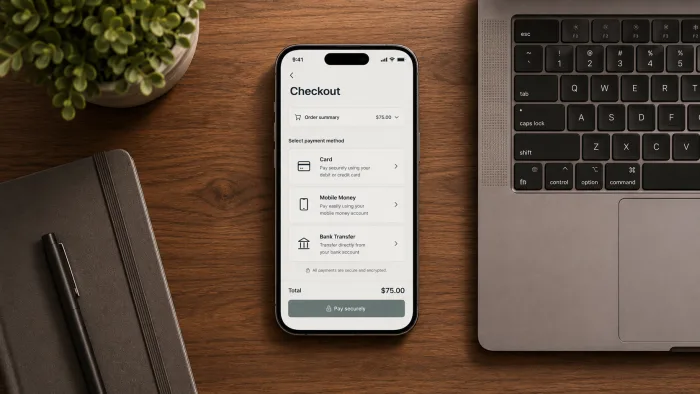
The documentation for most payment providers is excellent. It is clear, well-structured, and covers the integration path thoroughly. It tells you how to accept a card payment, how to handle a webhook, how to issue a refund. It is written for a world where your users have a card, your product operates in one or two currencies, and the payment experience is a single linear flow from checkout to confirmation.
That world exists. It is not the only world.
In markets where card penetration is low, where mobile money is the primary payment method for a significant portion of the population, where bank transfer volumes compete with card volumes, and where a user might reasonably expect to pay in any of three or four different ways depending on what they have available at that moment, the documentation stops being a complete guide and becomes a starting point for a much more complicated conversation.
This post is about that conversation. Not as a survey of payment providers or a tutorial on any specific integration, but as an honest account of what the complexity actually looks like at the product level and what it requires at the technical level to handle it well.
The docs tell you how to accept a payment. They do not tell you what to do when your users pay in four different ways, expect different checkout flows for each one, and occasionally switch methods mid-session.
THE MARKET COMPLEXITY THE DOCS ASSUME AWAY
Payment documentation is written with a payment method in mind. The Stripe docs assume a card. The M-Pesa API docs assume a mobile money prompt. The Flutterwave docs cover multiple methods but each one is documented in isolation, as if the product only ever uses one at a time.
The reality of building for complex markets is that the choice of payment method is itself a user experience decision, and it is one that carries cultural, economic, and practical dimensions that no documentation will surface.
Payment method as identity
In markets where mobile money is dominant, asking a user to pay by card is not just presenting an alternative. It can signal that the product was not built for them. A checkout that defaults to card input with mobile money as a secondary option communicates something about who the product considers its primary user, and users read that signal, often unconsciously, in ways that affect trust and conversion.
The inverse is also true. A product targeting corporate clients or international users that leads with mobile money prompts may create friction for users who expect a card-first experience. The default payment method is a product decision with real conversion implications, and it is one that most payment documentation does not address because it sits above the integration layer.
The fragmented provider landscape
In many complex markets, no single payment provider covers the full range of methods a product needs to support. A provider that handles card payments well may have limited mobile money coverage. A mobile money aggregator may not support international cards. A local bank transfer solution may have the most reliable infrastructure for high-value transactions but the worst API documentation of the three.
The practical implication is that a product serving a complex market often needs multiple payment providers simultaneously, with routing logic that directs each transaction to the appropriate provider based on the payment method selected, the transaction value, the user location, and occasionally the time of day when certain provider systems are under peak load.
That routing logic is not covered in any single provider documentation. It is product logic, built on top of multiple integrations, that has to be designed, maintained, and monitored independently of any single provider relationship.
Currency and settlement complexity
A product that accepts payments in multiple methods often accepts payments in multiple currencies, or in a single currency with multiple underlying settlement currencies. Mobile money settlements may happen in local currency on a different cycle than card settlements, which happen in a third currency that requires conversion before it reaches the product revenue account.
Reconciliation across these settlement streams is not a technical afterthought. It is a core operational requirement that has to be designed into the payment architecture from the beginning. A product that accumulates payment data across multiple providers without a reconciliation strategy discovers the problem at month end, when the numbers do not match and the investigation requires reconstructing transaction histories across three different provider dashboards.
WHAT THIS MEANS AT THE TECHNICAL LEVEL
The checkout flow is not one flow
A checkout that supports multiple payment methods is not a single flow with a payment method selector at the top. It is multiple flows, each with its own steps, its own feedback patterns, and its own failure modes, unified by a shared order state that persists across all of them.
A card payment flow is synchronous from the user perspective: enter details, confirm, receive result. A mobile money flow is asynchronous: initiate the prompt, wait for the user to approve on their device, poll or receive a webhook for the result. A bank transfer flow may be asynchronous over hours rather than seconds, with the user leaving the product entirely and returning after completing the transfer in their banking app.
Each of these flows requires different UI states, different timeout handling, different retry logic, and different communication with the user about what is happening and what they need to do. Building a checkout that handles all three cleanly, without the user feeling the seams between them, is a significant design and engineering challenge that the provider documentation does not prepare you for.
A checkout that supports multiple payment methods is not one flow with a selector at the top. It is multiple flows with different timing, different failure modes, and different user expectations, unified by a shared order state.
Webhook reliability is not guaranteed
Payment providers communicate transaction outcomes via webhooks: HTTP callbacks sent to an endpoint in your application when a payment succeeds, fails, or changes state. The documentation describes this mechanism clearly and makes it sound reliable.
In practice, webhooks are delivered over the public internet, which means they can be delayed, duplicated, or occasionally not delivered at all. A payment integration that assumes webhooks are reliable and processes them exactly once will eventually process a successful payment twice, or fail to process a successful payment because the webhook arrived out of order.
Idempotency is the technical solution: every webhook handler must check whether the event has already been processed before acting on it, using a unique event identifier stored in your database. Every state transition triggered by a webhook must be safe to apply multiple times without producing incorrect results. This is basic distributed systems practice but it is not mentioned in most payment provider documentation because it is assumed to be the integrating developer responsibility, not the provider responsibility.
Failed payments are a product experience, not an error state
Most payment integrations treat a failed payment as an error to be handled: show a message, offer a retry. In complex markets where payment method reliability varies, where mobile money prompts time out, where card networks have variable uptime, and where users regularly switch between methods when one does not work, the failed payment is not an edge case. It is a routine part of the payment experience for a meaningful percentage of transactions.
A product that handles payment failure well communicates clearly what happened, offers the right alternative immediately, preserves the order state so the user does not have to start over, and makes it easy to retry with a different method without creating duplicate orders. Each of these requirements has implementation implications that go beyond error handling and touch the order management, session state, and checkout flow architecture.
The cost of getting this wrong is not a bad error message. It is lost revenue from users who could not complete a legitimate purchase because the recovery experience was too confusing or too much friction.
Reconciliation requires a purpose-built data model
Every payment transaction generates data across multiple systems: the provider record, the order record in your application, the settlement record in the provider dashboard, and eventually the bank statement entry. In a single-provider integration, matching these records is straightforward. Across multiple providers, multiple currencies, and multiple settlement cycles, it requires a data model designed for the purpose.
The payment record in your application needs to capture enough information to reconstruct the full transaction history without relying on provider APIs that may be slow, rate-limited, or unavailable during a reconciliation run. Provider transaction IDs, payment method identifiers, currency and amount at the time of transaction, settlement currency and amount, provider fees, and the timestamp of every state transition the payment passed through: all of this needs to be stored locally at the time of the event, not fetched later.
A payment architecture that stores only the outcome and relies on the provider for everything else is one reconciliation audit away from a very difficult week.
THE DESIGN DECISIONS THAT DETERMINE CONVERSION
Beyond the technical architecture, the checkout experience in a complex payment environment is a design problem with direct revenue implications. The decisions that matter most are not the ones covered in provider documentation.
Which payment method to default to, and how to determine the right default for different user segments or geographies.
How to present multiple payment options without creating choice paralysis or signalling that the product is uncertain about its own market.
How long to wait for an asynchronous payment before showing a timeout state, and what to say when the timeout occurs.
How to handle the user who initiates a mobile money prompt, switches apps to approve it, and returns to find the product has timed out and cleared their session.
How to communicate a pending payment state that may resolve in seconds or in hours depending on the method, without the user assuming the product has failed.
None of these questions have universal answers. They require knowledge of the specific market, the specific user behaviour, and the specific payment methods involved. They also require the patience to test real checkout flows with real users on real devices, because the assumptions that seem reasonable in a development environment frequently break down in the field.
WHAT BUILDING FOR THIS COMPLEXITY ACTUALLY REQUIRES
A payment integration in a complex market is not a feature. It is a system: a set of provider integrations, routing logic, state management, webhook handling, failure recovery, and reconciliation infrastructure that has to be designed as a whole rather than assembled incrementally.
The teams and developers who do this well share a few characteristics. They treat the payment flow as a first-class product experience rather than a technical requirement to be fulfilled. They design for failure as carefully as they design for success. They build reconciliation capability before they need it rather than after the first audit reveals a gap. And they understand the market they are building for well enough to make the product decisions, not just the technical ones, that determine whether the integration actually serves the users it was built for.
The documentation will get you started. The market will teach you the rest. The developers who close that gap fastest are the ones who expected it to exist.
CLOSING THOUGHT
Payment integration is one of the few areas of product development where the gap between what the documentation describes and what production requires is both large and consequential. Every failed transaction that could have been recovered, every duplicate charge that should not have been processed, every reconciliation gap that surfaces at month end traces back to decisions made, or not made, during the integration. The docs are the beginning of the conversation. Understanding the market is what finishes it.